Your marketing team runs ads, posts content and answers leads every day. But most of them learned it on the job, from YouTube, or by trial and error with the company’s money.
If your company pays the HRD Corp levy, structured training for that team can be funded from the levy you have already paid. This guide explains how HRD Corp claimable digital marketing training works, what the application process looks like, and what a programme should cover so the money turns into better leads and sales, not just a certificate.
What is HRD Corp claimable digital marketing training?
HRD Corp claimable digital marketing training is a course on topics like Meta ads, content marketing, AI tools and lead follow up, delivered by a registered training provider, that a levy-paying employer can fund through an HRD Corp grant. The employer applies for the grant before the training date, the training is delivered, and the eligible costs are then claimed against the company’s levy balance.
The levy is already paid. The question is whether it gets used on training that moves your numbers.
Which HRD Corp schemes apply to marketing training?
Two schemes cover most marketing and sales training:
- HRD Corp Claimable Courses (HCC). The training provider, programme and trainer are registered with HRD Corp. This is the most common route for in-house corporate programmes and public courses.
- Skim Bantuan Latihan (SBL). More flexible on provider registration, and can cover internal trainers. The documentation and approval requirements differ.
For an in-house programme run only for your team, HCC in-house training is usually the simplest path. If staff from more than one company attend together, a joint in-house arrangement may apply. Check the current scheme rules and HRD Corp’s Allowable Cost Matrix with your HR or the HRD Corp support centre, because conditions and limits are updated from time to time.
How do you apply for an HRD Corp claimable course?
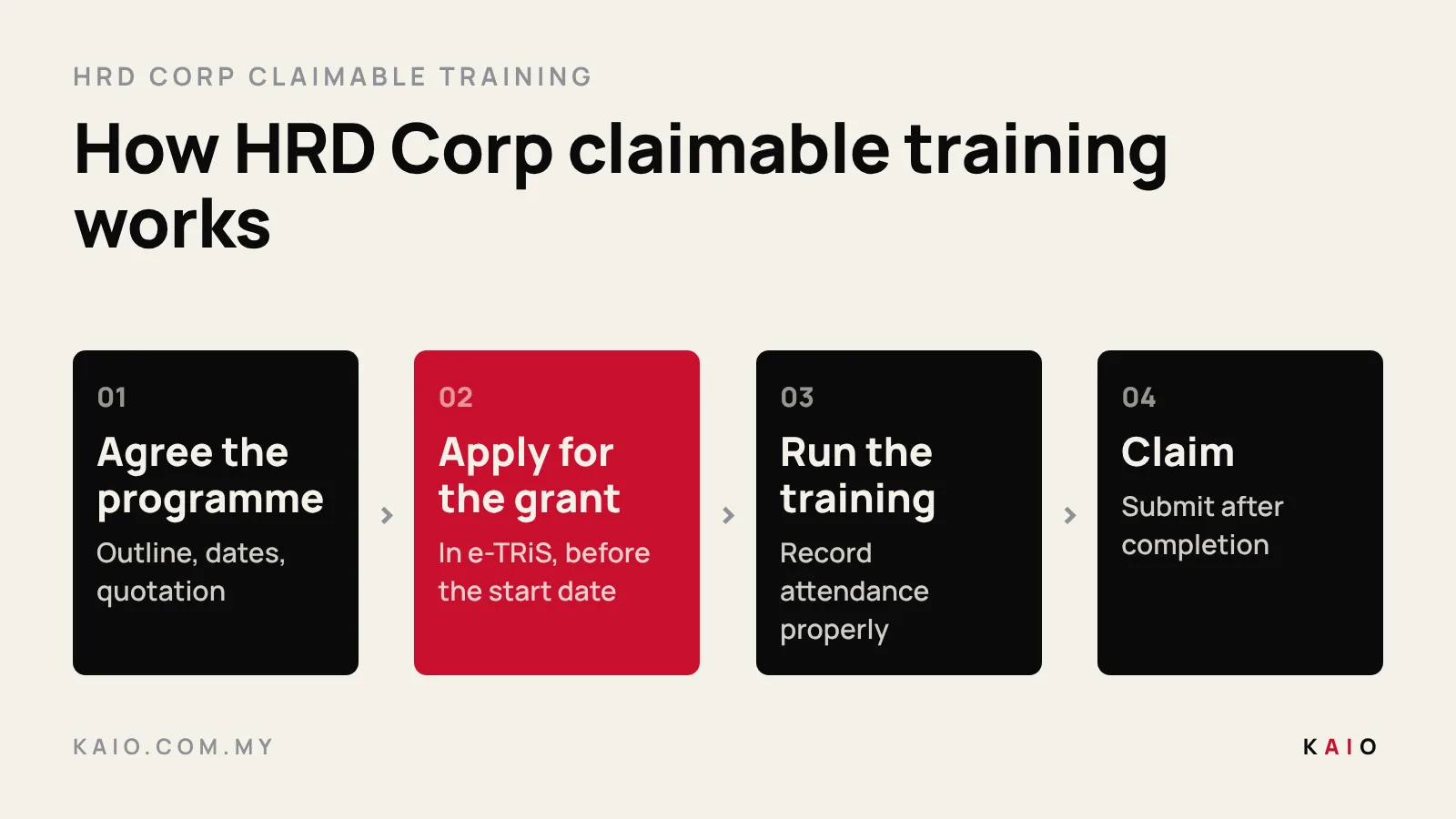
The employer applies for the grant online through HRD Corp’s e-TRiS system before the training starts, using the provider’s quotation, training schedule and trainer profile. After the training is delivered and attendance is recorded, the provider submits its claim and the employer completes the claim within the period HRD Corp sets.
In practice:
- Agree the programme. Confirm the outline, dates, number of participants and quotation with the training provider.
- Apply early. Submit the grant application in e-TRiS within the required notice period. For in-house training HRD Corp has generally required at least 14 days before the start date, so plan a month ahead to be safe.
- Run the training. Make sure attendance is recorded properly, because claims are tied to actual attendance.
- Claim. Submit the claim with the required documents after the training is completed.
Notice periods have changed during 2026, so always confirm the current rule on the HRD Corp website or with the support centre before you lock dates.
What should a digital marketing training programme cover?
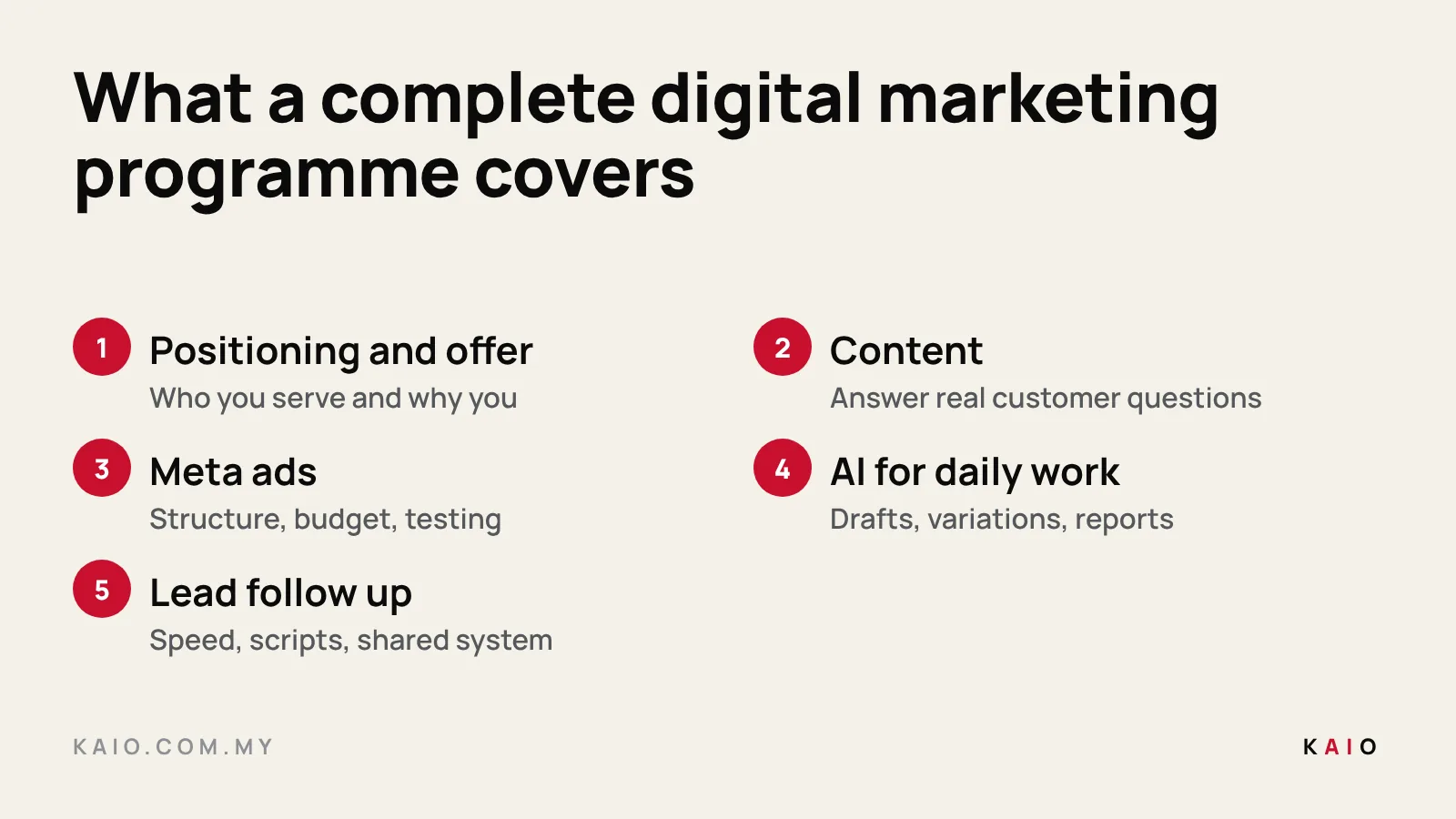
A useful programme covers the full path from attention to closing, not just one platform. For most Malaysian service and product businesses, that means:
- Positioning and offer. Who you serve and why they should choose you.
- Content that answers real customer questions. Short video, posts and articles.
- Meta ads. Campaign structure, budget, creative testing and reading results. See the Meta ads guide for service businesses.
- AI for daily marketing work. Content drafts, ad variations and reporting. See AI untuk marketing bisnes.
- Lead handling and follow up. WhatsApp scripts, response time and a shared follow-up system. See the WhatsApp follow-up system.
Training that stops at marketing and ignores the sales team usually produces more leads but not more sales. The best programmes include both teams, or at least the hand-off between them.
How do you choose the right trainer?
Look for three things: the trainer is HRD Corp accredited and works with a registered provider, the trainer has actually run marketing and ad budgets in a business like yours, and the programme ends with work your team can use the next day, such as campaign setups, scripts and templates, not just slides.
Questions worth asking before you sign:
- Which industries have you run campaigns for, and at what budget?
- Will the programme be adapted to our products, customers and current ads?
- What will my team have produced by the end of the training?
- Is there any follow up after the session?
More on this in how to choose a corporate trainer in Malaysia.
A note on my own programmes
I am an HRD Corp Accredited Trainer with NCS Train-The-Trainer certification. Before training, I ran Meta ads and lead pipelines in car dealerships, healthcare, product and service businesses, and I have managed more than RM500K in ad spend. Organisations I have trained include car dealer sales teams for Honda, Proton, Perodua and JAECOO, and a corporate communications team at the Ministry of Health (KKM).
My in-house programmes cover AI training, Meta ads, content and sales team training, adapted to each company’s products and customers.
Frequently asked questions
Is all digital marketing training HRD Corp claimable?
No. The training must be delivered under an HRD Corp scheme, usually by a registered provider with a registered programme and trainer, and the employer must apply for the grant before the training date. A course that is not set up this way cannot be claimed afterwards.
Can small companies use HRD Corp funding?
Yes, if the company is registered with HRD Corp and has a levy balance. The amount available depends on the levy the company has contributed, so smaller companies may need to plan training around their balance.
Can we claim training that has already happened?
Generally no. The grant application has to be submitted and approved before the training starts, within the notice period HRD Corp sets.
How many participants should join an in-house session?
For hands-on marketing and AI training, 10 to 25 participants works well so everyone can practise on real campaigns and content. Larger groups are possible with more facilitation.
What costs can be claimed besides the course fee?
Depending on the scheme and training type, items such as meals, allowances, materials, venue and travel may be claimable. Refer to HRD Corp’s latest Allowable Cost Matrix for the current list and limits.
Next step
If you want an HRD Corp claimable programme for your marketing or sales team, see the programme outline and enquiry details at Corporate Training.

HRD Corp Accredited Trainer. 13 tahun dalam content creation, dan dalam digital marketing sejak 2015. Pernah uruskan marketing dan pipeline leads dalam industri car dealership, healthcare, bisnes jual produk dan bisnes servis. Kini melatih team marketing dan sales syarikat.